
Missed Part 1? Read it here.
This website version is always the most up-to-date version. Articles evolve and are sometimes revised. Previous publications and other versions of Part 2 of this article can be found below:
- Belgian Shiatsu Federation (BSF) — October 2026
Publication of the thoroughly revised edition for subscribers: Dutch · French - Shiatsu Society Journal (Substack) — August 2026
Original English-language version for subscribers: Substack - Shiatsu Society Journal (UK) — July 2026
Original English-language version: PDF
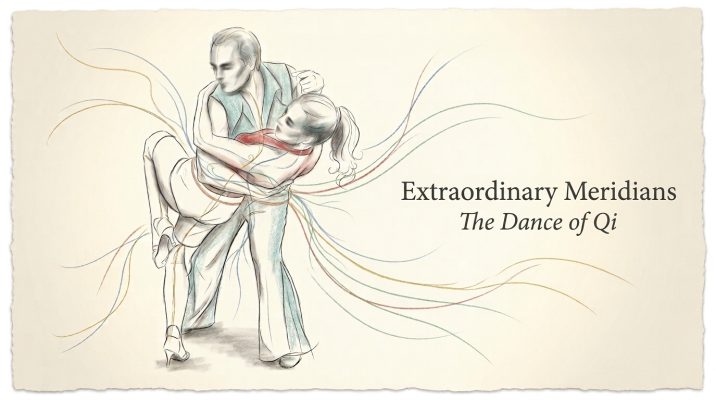
In the first part of this article, we explored the foundations of the eight Extraordinary Meridians alongside a practical three-phase model — stabilisation, transformation, and integration — to illuminate their role within Shiatsu practice. In this second part, the focus shifts from structural understanding to a more direct and experiential approach. Through the metaphor of dance, we explore how Qi moves through the Extraordinary Meridians, how this dynamic shapes the interaction during a session, and how it supports the development of presence, attunement, and rhythmic awareness in the Shiatsu practitioner.
Whereas Part 1 primarily offered a historical, theoretical, and clinical framework for reflection, this second part embraces a more symbolic and experiential reading. Here, the Extraordinary Meridians are approached not as rigid theory, but as living metaphors. In this way, the subtle yet tangible movement of Qi within the therapeutic encounter becomes easier to sense and experience.
This approach to the Extraordinary Meridians closely reflects my own experience. Dance is deeply rooted in my life. As a young adult, I began exploring the language of the body through dance and song. My encounter with Latin American dance grew into a true passion. I was part of several dance teams and taught classes for a period of time, both in Belgium and abroad. These experiences opened the way to a deeper inward journey, which eventually led me to Shiatsu.
Through dance, I learned to experience connection as a subtle form of attunement: grounded in one’s own axis, with one’s feet firmly rooted in the earth, one can reach out to another person without clinging to them or forcing them into a movement. Through the heart area, the solar plexus and the breath, a natural and intuitive connection emerges between the two partners, creating space for flow and moments of peaceful stillness. Today, alongside Shiatsu and Do-In, I continue to give introductory salsa workshops. Through the written word, I delight in sharing this passion for connection.
As a point of orientation, the eight Extraordinary Meridians are briefly revisited below, this time as an introduction to their role within the metaphor of the dance of Qi:
- The Yin and Yang Qiao Mai open the dance; they regulate presence, gaze, and stability in the here-and-now, laying the foundation for the first phase of stabilisation. Here, the Yin Qiao Mai represents inward movement and introspection, while the Yang Qiao Mai embodies outward movement and engagement.
- The Dai Mai provides horizontal connection and forms a supportive container — a safe holding space in which the dance can emerge, allowing the choreography to unfold with coherence and integrity within its own boundaries.
- The Ren Mai, Du Mai, and Chong Mai form the vital core; together they express the deep melody, the underlying rhythm, and the blueprint of life, thereby opening the space for profound transformation. The Ren Mai expresses the Yin direction as a melodic current, the Du Mai embodies the Yang direction through rhythm and strength, while the Chong Mai, as the core meridian, carries the underlying blueprint of life itself.
- Finally, the Yin and Yang Wei Mai connect all experiences and weave them into a coherent and integrated whole, ensuring that the movement of the dance does not end with the final chord, but continues to resonate as an inner compass throughout daily life. In this process, the Yin Wei Mai brings depth by integrating emotional experience and meaning, while the Yang Wei Mai coordinates and guides the movements, maintaining perspective in interaction with the world.
The descriptions below draw upon the classical functions and associations of the Extraordinary Meridians within Chinese medicine and Daoist traditions, and are further explored through a personal, symbolic, and contemplative interpretation.
The Extraordinary Meridians as the Choreography of Life
To deepen our understanding of the eight Extraordinary Meridians, we may imagine them as eight unique performers within a choreography of Qi. Each meridian plays its own role, with its own energy and rhythm — together, they form a vibrant and harmonious ensemble. Below, we encounter these eight “performers” and the distinctive part each one plays within this dance of Qi.
Yin Qiao Mai — Female Dancer
Together with the Yang Qiao Mai, the Yin Qiao Mai opens the dance and lays the foundation for the first phase of stabilisation.
- Function: regulates rest and the inner foundation; turns the gaze inward and supports sleep and reflection.
- In the dance: embodies soft, gliding movements, sustained postures, and introspection; using the breath as its rhythm.
- Archetype: inner balance and gentleness.
- Personality: connects the inner world with deep rest; safeguards the boundary between inner and outer experience.
- Voice of the meridian: ‘Turn your gaze inward and rest within your own centre. Here, form begins to take shape. Find your inner axis and listen to yourself.’
Yang Qiao Mai — Male Dancer
Together with the Yin Qiao Mai, the Yang Qiao Mai forms an intimate dancing pair, attuning inner stillness to the movement of the outer world.
- Function: regulates alertness and readiness for action; directs the gaze outward and guides swift responses.
- In the dance: brings expressive power, leaps, turns, and crossing movements; guiding rapid transitions.
- Archetype: mobility, action, and initiative.
- Personality: playful, active, and exploratory; attunes presence to the surrounding space.
- Voice of the meridian: ‘Turn your gaze outward and widen your focus. Follow me into the movement of the world; I guide your steps, leaps, and turns.’
Dai Mai — Costume Director
As the only horizontal meridian, the Dai Mai holds everything together; it creates a safe container in which the other performers can move freely.
- Function: wraps the “costume” around the waist; forms a physiological anchor that prevents the dance from becoming chaotic.
- In the dance: determines when the dancing pair comes together or parts; regulates the vertical organisation of all performers.
- Archetype: guardian of the supporting structure and holding field.
- Personality: brings order to chaos, centres energy, and preserves strength by gathering fragmented patterns.
- Voice of the meridian: ‘I am the belt around your waist. Wait… breathe in and feel your contours before you move on. Trust in my support; I bring order and structure.’
Ren Mai — Conductor of the Yin Orchestra
The Ren Mai provides the melody upon which the dance unfolds: fluid, warm, and supportive.
- Function: creates the harmonic foundation, a gentle, undulating fertile ground upon which all movement rests.
- In the dance: supports deep, gliding movements and the introspective moments of the Yin Qiao Mai.
- Archetype: sacred feminine energy and pure holding field.
- Personality: nurturing, receptive, and connective; fosters bonding, intimacy, and emotional flow.
- Voice of the meridian: ‘Come, I will carry you. Feel the music within yourself.’
Du Mai — Conductor of the Yang Orchestra
The Du Mai brings rhythm, pulse, and power — the percussion of the performance.
- Function: forms the vertical axis of strength; activates ascending energy, nourishes the brain, and provides direction.
- In the dance: offers stability, vital impulse, and masculine guidance to the movements of the Yang Qiao Mai.
- Archetype: the inner backbone and authority.
- Personality: courageous, active, and direct; brings clarity and protects the choreography from formlessness and collapse.
- Voice of the meridian: ‘Stand upright. Move forward. This is the path.’
Chong Mai — Choreographer and Primordial Mother of the Dance
The Chong Mai writes the script of the entire performance and determines its rhythm, themes, and underlying tone.
- Function: creates the primordial framework of the life pulse; forms the deep, central heartbeat from which all meridians emerge.
- In the dance: gradually reveals the deep thematic layers and gives the other dancers their most essential inner motivation.
- Archetype: the primordial source and ancestral mother.
- Personality: still, wise, and bearer of universal memory; can manifest as overwhelming waves of emotion.
- Voice of the meridian: ‘I am the origin of your life path, the very first heartbeat. I am your deepest motivation. Dance from your source.’
Yin Wei Mai — Weaver of Stories
The Yin Wei Mai connects all preceding movements with the inner world, giving the choreography an emotional memory.
- Function: brings inner experiences and memories to the surface; weaves scattered moments into a meaningful life narrative.
- In the dance: accompanies moments of deep contemplation and reveals the emotional layering of the choreography.
- Archetype: integration of Yin experience and meaning.
- Personality: connects experience with feeling; links past and present, and modulates emotional depth.
- Voice of the meridian: ‘Just feel. Every memory and every emotion is woven into this moment. This is where the dance gains meaning.’
Yang Wei Mai — Executive Director
The Yang Wei Mai holds an overview of the entire space and seamlessly weaves together all external Yang forces.
- Function: perceives where the dance is heading; coordinates timing and integrates the outer world into a unified whole.
- In the dance: provides the invisible direction behind the scenes, making external orientation, contact, and cohesion possible.
- Archetype: integration of Yang information and interaction with the outside world.
- Personality: oversees complexity; connects external stimuli with action pathways and enables strategic response.
- Voice of the meridian: ‘Look ahead, this is the most suitable path. Follow the choreography of the whole; I connect your steps with the world and gather the forces into one field.’
The Duet: The Dance of Balance
Together, the Yin and Yang Qiao Mai perform an ongoing choreography. Where the Yang Qiao Mai initiates action and opens toward the world, the Yin Qiao Mai guides the movement back into balance and opens inner space. The Yang Qiao Mai creates the tension in the body that allows the leap, after which the Yin Qiao Mai receives and softens it into a safe landing. Thus, one perceives opportunities in the outer world, while the other brings meaning and inner clarity.
Within classical Chinese medicine, they jointly regulate the opening and closing of the eyes, both literally and metaphorically. They govern lateral movement, balance, and posture, determining whether we move outward or turn inward. Their duet reflects the dance of life itself: how do we move through the world, and how do we return to ourselves? Their duet mirrors the dance of life itself: how do you move through the world, and how do you return to yourself?
The Extraordinary Meridians as a Mirror for Self-Reflection in Shiatsu Practice
When giving Shiatsu, it is helpful to see the experience as a dance between two people, rather than as a process in which an active therapist applies pressure with their fingers to a passive patient. The Shiatsu practitioner uses their whole body as a lever to give support and pressure; and the receiver is far from a motionless object, but rather a source of subtle movement to which the practitioner attunes, and which provides support and counterbalance for the practitioner’s movements.
— Carola Beresford-Cooke, Shiatsu: Theory and Practice (2016)
In practice, this dance functions as a powerful mirror for the Shiatsu practitioner’s posture, intention, and energetic presence. The three phases of our clinical model — stabilisation, transformation, and integration — are therefore directly reflected in the different layers of our own awareness and craftsmanship. It invites the reader to cultivate active mindfulness throughout a Shiatsu session:
Yin Qiao Mai — Stability from within
- Self-reflection: How graceful and fluid is my own movement? Do I feel my internal balance before I touch the receiver?
- Observation: Notice whether your breath and your own weight remain stable as you follow the receiver’s movement.
Yang Qiao Mai — Balance in outward action
- Self-reflection: Can I attune rhythm, power, and direction to the outer world without forcing?
- Observation: Notice whether your impulses synchronise with the subtle responses in the receiver’s body.
Dai Mai — Horizontal integration, the “belt”
- Self-reflection: Can I offer both structure and space? Am I fully present as a container while the receiver moves?
- Observation: Notice whether your touch remains continuously connected across the receiver’s body, without fragmentation.
Ren Mai — Anterior line, Yin quality
- Self-reflection: How subtle, mindful, and melodic is my touch? Am I truly listening to the inner rhythm of the other?
- Observation: Notice how you protect and support the receiver, as if offering a safe, gentle holding space, like a parent softly holding a child.
Du Mai — Posterior line, Yang quality
- Self-reflection: How grounded, focused, and clear is my intention? Can I guide the pulse of the dance without dominating?
- Observation: Ensure that your orientation and alignment remain strong, while maintaining your own physical relaxation.
Chong Mai — Deep core meridian
- Self-reflection: To what extent does my Shiatsu reflect my own life path and inner essence? Can I remain silently present with intense energies?
- Observation: Be the absolute stillness and wisdom required to hold a safe, non-judgemental space for the other.
Yin Wei Mai — Integration of the inner world
- Self-reflection: Can I hold within myself the emotional depth or vulnerability that has been touched, without being overwhelmed by it?
- Observation: After deep phases of transformation, notice how the receiver’s heart rate and breathing stabilise, and attune your own presence to this rhythm.
Yang Wei Mai — Transition to the outer world
- Self-reflection: How do I guide the transition from deep inner encounter back to everyday reality? Do I hold the space as the final chord approaches?
- Observation: Notice how the receiver’s tone and vitality restore during the closing phase, and how the energetic flow of this exchange naturally releases.
By integrating these reflective questions and observations, working with the Extraordinary Meridians becomes not only a physical practice, but also a practice of awareness, rhythm, balance, and connection — for both the Shiatsu practitioner and the receiver.
Like any metaphor, this dance is not meant to explain, but to invite attunement, experience, and reflection.
Final Cadence of Qi
Every touch is a step, every breath a movement.
The Extraordinary Meridians whisper the choreography of your own energy, at once gentle and powerful.
In the interplay of giving and receiving, rhythm, balance, and a sacred space for being emerge.
Thus, Shiatsu becomes not just a technique, but a living dance in which body, mind, and heart come together.