This website version is always the most up-to-date version. Articles evolve and are sometimes revised. Previous publications and other versions can be found below:
- Shiatsu Society Journal (Substack) — publication date to be announced
English-language publication of the thoroughly revised edition for subscribers: Substack - Shiatsu Society Journal (UK) — October 2026
English-language publication of the thoroughly revised edition: PDF - Belgian Shiatsu Federation (BSF) — November 2025
Original version: Dutch · French
The Three Treasures of life — Jing (Essence), Qi (Life Force), and Shen (Spirit) — are well-known concepts within Eastern traditions. But have you truly experienced the energetic interplay of these three in your encounter with another?
This article is a poetic exploration of how the Three Treasures — San Bao (三寶) — interweave within contemporary Shiatsu practice. I invite you to the sacred intersection where the vertical axis and horizontal openness meet — a place where heaven and earth touch, and where listening with both body and heart can create space for healing. Inspired by Eastern philosophy and my own experiences on the futon, this text is an invitation to reflection and deeper understanding.
A Simple Ritual, A Profound Meaning
When I began my Shiatsu training, I learned a simple ritual to open and close each session.
I sought out my vertical heaven–earth axis and stilled my thoughts—Shen, symbolising luminous consciousness. I opened my heart—the place where Shen finds shelter. A calm Shen allows emotions to be experienced harmoniously in connection with others. I then brought my attention to my hara—my lower abdomen centre that symbolises my connection to my deepest self and grounds me physically.
This ritual allowed me to work grounded, focused, and from a place of inner silence. Each session ended with a brief closing: a respectful way to release the connection and return to my own core.
What initially seemed like a formal gesture gradually became a gateway to something far deeper. I began to experience how this simple ritual set Jing, Qi, and Shen — the Three Treasures of life — in motion. It became an exercise in presence, a way of truly meeting the other.
The Three Treasures — San Bao
In the practice of Shiatsu, the encounter is central. What actually happens when the giver’s hands rest on the receiver’s body? Behind that seemingly simple touch lies an ancient energetic structure, deeply rooted in Eastern traditions.
In Chinese tradition, three fundamental “treasures of life” are distinguished:
- Jing: the root of our physical existence; stored in the Kidneys and felt in the hara; it provides stability, vitality and form.
- Qi: the vital, flowing force; bridging Jing and Shen; expressed through our breathing, movement and presence.
- Shen: the light of consciousness; reflected in clarity and joy; connecting us with the greater whole.
When the flow between Jing, Qi, and Shen is harmonious, a field of resonance emerges, allowing the person and life itself to move in natural harmony.
San Bao in Two Traditions
The term San Bao appears in classical Chinese medicine, Taoist traditions, and Buddhism.
In the medical and Taoist context, it refers to Jing, Qi, and Shen — the vital forces that sustain life.
In Buddhism, it refers to the Three Jewels: Buddha (awakening), Dharma (the teaching, the natural order), and Sangha (the community).
Both traditions reveal the same threefold movement: from the physical to the subtle, from form to consciousness. For me, this creates an inner coherence: San Bao shows how body, energy, and spirit form a single continuum, and how that unity comes to life in every Shiatsu session.
At the Crossroads of Horizontality and Verticality
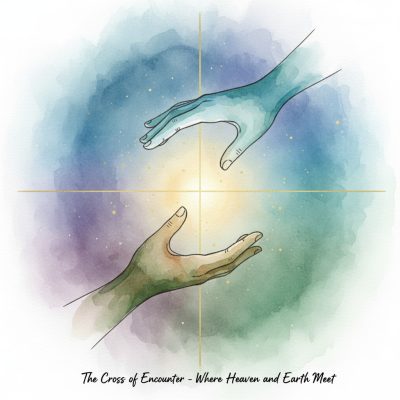
During a Shiatsu session, there is a constant interplay between two dimensions: the vertical axis of the giver — grounded, connected from heaven to earth — and the horizontal openness of the receiver — extended, receptive, and in a state of surrender.
The Human Being as Centre
Within the body, these two dimensions meet in the hara — the centre of the lower abdomen where our physical presence and energetic grounding can be felt. Within this space, the kikai tanden is experienced as an energetic centre, associated with the area of the acupuncture point Ren Mai 6 (“Sea of Energy”).
Another important point within the hara is Ren Mai 4 (“Gate of Jing”), traditionally regarded as a point that nourishes and strengthens Jing. From this centre, Qi can symbolically rise through the Chong Mai, which is considered a central axis between earth and heaven. This vertical connection allows the Shiatsu practitioner to become a guide between both poles — rooted, open, and present.
We recognise this same movement in the Five Elements. Symbolically, I experience it as a journey that begins with Water — the source of our Jing and the Kidneys. From there, it flows through Earth — our horizontal connection with others, embodied by the Stomach and Spleen — toward Fire, where the Heart and Shen open into consciousness and joy.
The Cross as a Universal Symbol
The intersection of horizontal and vertical forces evokes the Christian cross, where heaven and earth, the divine and the human, meet. In Shiatsu too, these forces converge in the middle — the living centre where transformation becomes possible.
Energetic Density and the Threefold Reality
The Three Treasures represent different densities of energy:
“These Three Treasures represent three different states of condensation of Qi — the Essence being the densest, Qi the more rarefied, and the Mind the most subtle and non-material.”
— Giovanni Maciocia, The Foundations of Chinese Medicine, 2015
This refinement can also be found in other spiritual traditions. For me, the Christian Trinity — Father, Son, and Holy Spirit — evokes a symbolic parallel with the Three Treasures:
- The Father as the source or Essence (Jing).
- The Son as the connecting force that manifests in the world (Qi).
- The Holy Spirit as the subtle field of awareness (Shen).
Thus, different traditions reveal similar patterns, in which origin, movement, and consciousness form one continuous whole.
Tori and Uke — Giving and Receiving
In Japanese disciplines such as Budo (“the way of the martial arts”) and from a similar perspective within Shiatsu, we can speak of Tori (取り) — the one who performs the action or gives the technique — and Uke (受け) — the one who receives and participates in shaping the experience. Although these terms may appear simple, they refer to a refined dynamic of presence, trust and exchange.
Tori and Uke primarily describe the relationship between two people within an encounter. When the emphasis lies on applying and receiving a technique, this dynamic can also be described through the terms Jutsusha (術者) — the one who applies the technique — and Jusha (受者) — the one who receives it. These terms highlight the complementary roles within a treatment or method.
Within Shiatsu, the practitioner is referred to as Shiatsu-shi (指圧師). The term literally means “one who practises the skill of Shiatsu” and refers to a practitioner who does not merely perform a technique, but embodies it through presence, sensitivity and awareness (Shen). The Shiatsu-shi moves from their own centre and attunes to the other.
The encounter is never one-directional: both are moved. Uke opens, creates space and allows the movement of Qi to become perceptible. In this context, the art of receiving is as essential as the art of giving. Through surrender and presence, Uke also practises an art — the art of receiving.
When Tori and Uke truly meet through their hara, a living field of resonance emerges in which healing and growth can arise spontaneously.
Western Terminology in a New Light
The word therapist originates from the Greek therapeutès, originally meaning “servant” or “caretaker.” Through its use in a medical context, it later came to mean “one who treats a disease.” In modern usage, it is often associated with “healer.” Patient comes from patiens: “the one who endures” or “suffers.”
In the context of Shiatsu, both terms prove only partially adequate. Both giver and receiver participate in a process of awakening. The dynamic is reciprocal: the one who gives, receives; the one who receives, gives.
As a Shiatsu-shi, you can truly offer only after fully welcoming your client. A sincere reception creates a safe space in which Uke dares to surrender and open up, completing the reciprocity of giving and receiving. This is a subtle interplay of vulnerability and presence.
In this way, the encounter between Tori and Uke becomes a living field where energy, attention, and consciousness converge — the place where Shiatsu reveals its deepest meaning.
The Place of Transformation
In Shiatsu, transformation can emerge at the meeting point of horizontal and vertical energy. The receiver (Uke) opens horizontally, becoming receptive to contact, while the Shiatsu-shi stands in their vertical axis — rooted, centred and aware. At this crossroads, energy can flow freely, giving rise to a dynamic exchange that subtly touches both participants.
This meeting of energies echoes insights from the Yi Jing (better known as the I Ching), the ancient Chinese Book of Changes. The Yi Jing invites us to understand the meeting point where heaven and earth converge as the place where the ‘ten thousand transformations’ arise. It is precisely at this intersection—where the horizontal and vertical dimensions meet—that change becomes possible.
The Yi Jing describes the dynamics of the universe through 64 hexagrams, each consisting of a combination of six broken and solid lines. These lines symbolise Yin (passive, receptive energy) and Yang (active, radiating energy) and their continuous interplay.
Each hexagram represents a specific situation or pattern of energy. In Shiatsu, this can be seen as a metaphor for the encounter between Tori and Uke: the “lines” of both individuals intersect and influence one another, creating a new energetic pattern. Just as the Yi Jing shows that every situation contains the possibility of transformation, Shiatsu reveals how countless possibilities for personal growth and change can arise at the intersection of horizontal and vertical energies.
Carl Jung noted this insightfully:
“The meeting of two personalities is like the contact of two chemical substances: if there is any reaction, both are transformed.”
— C.G. Jung, Modern Man in Search of a Soul (1933)
When two people meet with open presence, mutual transformation occurs — subtle, energetic, and often unconscious. The Yi Jing supports this understanding: change is constant and all-encompassing, and the crossroads of energies provides a space where this change can unfold.
In every Shiatsu session, such subtle alchemy takes place. In practice, this means that each encounter is an opportunity for renewal: for the receiver to dare to surrender and thus receive, and for the Shiatsu-shi to remain fully present, aware of the flow of Jing, Qi, and Shen. The intersection thus becomes a living laboratory of energetic possibilities.
See No Evil, Hear No Evil, Speak No Evil — A Path of Consciousness
The three wise monkeys — Mizaru (see no evil), Kikazaru (hear no evil), and Iwazaru (speak no evil) — are an ancient Japanese symbol, originating from Buddhist and Confucian traditions. They remind us of the importance of inner purity and conscious attention. They also represent another form of trinity: hearing, seeing, and silence. From an energetic perspective, I feel they can also be understood as a form of inner cultivation:
- Hearing (Jing): opening to what truly is.
- Seeing (Qi): perceiving the dynamics of energy.
- Silence (Shen): remaining present in stillness, without judgment.
Thus, the three monkeys become a metaphor for listening with the hands, perceiving with the body, and being present with the mind. They remind us that inner growth emerges through conscious encounter and mutual respect, rather than through technique alone.
The Art of Listening
For me, Shiatsu is “the art of listening with body and heart”. Listening here goes beyond ears or intellect: it is attuning to the resonance between myself and the receiver, with an open heart and without judgment. The body acts as an antenna, subtle and sensitive to the movement of energy.
Shiatsu is much more than technique; it is an art of encounter and presence. By consciously working with the Three Treasures, the hara, and the vertical axis of life, and by understanding the dynamics of Tori and Uke, a deeper layer of integration and awareness can be experienced. It thus becomes an art of living: a harmonious flow of Jing, Qi, and Shen — earth, energy, and heaven — within ourselves and in the other. The intersection of verticality (our inner spiritual experience) and horizontality (our earthly, social connection) reveals the universal field of encounter and connection.
Ultimately, Shiatsu transcends words. Focus, intention, and inner stillness open the door to other dimensions of perception, where distances dissolve and clarity and direct knowing become possible — a state that can only be experienced with humility.