

This website version is always the most up-to-date version. Articles evolve and are sometimes revised. Previous publications and other versions of Part 1 of this article can be found below:
- Belgian Shiatsu Federation (BSF) — September 2026
Publication of the extended and thoroughly revised edition, including a new conceptual clinical model: Dutch · French - Shiatsu Society Journal (Substack) — May 2026
Original English-language version for subscribers: Substack - Shiatsu Society Journal (UK) — April 2026
Original English-language version: PDF
Introduction
When I began my Shiatsu training, perceiving ‘energy’ sometimes proved difficult to interpret. How can one experience something that is neither visible nor tangible?
A quote by Gabrielle Roth, founder of the 5Rhythms movement, became an important source of inspiration for me:
Energy moves in waves. Waves move in patterns. Patterns move in rhythms. A human being is just that: energy, waves, patterns, rhythms. Nothing more. Nothing less… A dance.
— Gabrielle Roth, 1989
How does energy flow through the body? Which subtle, hidden pathways connect body and mind?
This first part takes the reader on a fascinating journey of discovery along the Eight Extraordinary Meridians (Qi Jing Ba Mai, 奇經八脈) — also referred to as ‘extraordinary vessels’ or simply ‘vessels’. We explore their historical roots and theoretical foundations, from the earliest classical texts to the deep alchemical traditions.
Building on this foundation, I introduce a conceptual clinical model: a heuristic three-phase framework designed to support reflection and clinical practice for the modern Shiatsu practitioner. Although deeply rooted in my own life experience, personal growth, and transformations on the futon, this model is still exploratory in nature; it offers a structured way of translating the subtle and often abstract dynamics of these meridians into the practical reality of Shiatsu treatment.
Yet this is only the beginning. In the second part of this article, these theoretical foundations are brought to life through an evocative ‘Dance of Qi’, in which the Extraordinary Meridians reveal their choreography and energy becomes directly experiential.
1. Historical and Theoretical Foundations of the Extraordinary Meridians
1.1 The Long Journey of the Extraordinary Meridians: A Historical Overview
A number of the Extraordinary Meridians (specifically the Ren, Du, and Chong Mai) are already mentioned in the Huangdi Neijing (Yellow Emperor’s Inner Classic), compiled between the second century BCE and the second century CE. Although the text also contains shorter, fragmented references to the Dai Mai and the Yin and Yang Qiao Mai, the Yin and Yang Wei Mai are still virtually absent here. Within this corpus, the Suwen (Basic Questions) provides the theoretical foundations, in which these mentioned Extraordinary Meridians are linked to the human life cycle and reproduction. In addition, the Ling Shu (Spiritual Pivot) discusses the pathway of these Extraordinary Meridians, their energetic functions, and the application of acupuncture points.
However, these texts provide early references rather than a fully developed theory of the Extraordinary Meridians. Later, the Nan Jing (Classic of Difficult Issues), traditionally dated to the first or second century CE, clarified these often cryptic passages, notably by systematising the relationships between meridians, Qi, and diagnostic patterns, and organizing the Extraordinary Meridians within a coherent framework.
In parallel, Daoist external alchemy (Waidan) continued to develop, gradually providing a cosmological and energetic framework within which internal alchemy (Neidan) would later emerge. From the Song period onwards (around the tenth century), the Extraordinary Meridians gained a more prominent symbolic and energetic significance within Neidan as a connection between body and mind. This vision is clearly illustrated in the Neijing Tu (Diagram of the Inner Landscape). Although the most famous version of this diagram dates from the nineteenth century, it forms a visual synthesis of earlier Neidan concepts regarding internal energy circulation, in which the Extraordinary Meridians Ren and Du Mai — and to a lesser extent Chong and Dai Mai — can be symbolically recognized through their trajectories and interconnections.

During the Ming dynasty, Li Shizhen processed and systematised the theory of the Eight Extraordinary Meridians in the Qi Jing Ba Mai Kao (Study of the Eight Extraordinary Meridians). Shortly thereafter, the Zhenjiu Dacheng (Great Compendium of Acupuncture and Moxibustion, 1601) further consolidated the position of the Extraordinary Meridians within the meridian system.
1.2 The Extraordinary Meridians: Deep Reservoirs of Qi
Within classical Chinese medical theory, the Eight Extraordinary Meridians function as deep reservoirs or ‘lakes’ of Qi, closely connected with Jing. They absorb and redistribute deficiencies or excesses arising within the flowing rivers of the twelve primary meridians, thus maintaining balance throughout the entire energetic system.
With the exception of the Ren Mai and Du Mai, the Extraordinary Meridians do not possess their own independent sequence of acupuncture points; they ‘borrow’ points at the intersections of their pathways with the primary meridians. In practice, these pathways are opened and activated via specific opening and coupled points on the primary meridians.
Although classical texts often describe a single directional flow, clinical and experiential practice assumes that Qi within these deep channels can move in both directions, depending on what regulation is required.
Classical sources associate the Extraordinary Meridians with the Extraordinary Fu (Curious Organs) and with major life phases such as growth, maturation, and ageing. They are also understood as supporting the constitutional layer: the underlying pattern that partly determines how a person functions, responds, and recovers.
1.3 The Unfolding Body: Extraordinary Meridians as a Blueprint from Conception
In classical Chinese medical embryology, the Extraordinary Meridians are the first energetic structures of the human body to form during conception and embryonic development. They arise before the twelve primary meridians and lay down a blueprint that underpins growth and development.
Although no single universal sequence appears across all classical texts, the most widely accepted traditional order — according to sources such as the Nan Jing, Ling Shu, and classical embryological models — is as follows.
The first meridian to emerge is the Chong Mai, the central axis of the embryo. It arises from the combined Jing of both parents and forms the ‘Sea of Blood and Meridians’, from which all other meridians originate.
From the Chong Mai, the Ren Mai develops as the anterior midline, regulating Yin, embodiment, and reproduction. The Du Mai forms the posterior midline, supporting Yang, directionality, and the nervous system. Together, these three constitute the fundamental structure of the body.
Subsequently, the Dai Mai emerges as the only horizontal meridian, connecting and stabilising the upper and lower body. This is followed by the Yin Qiao Mai and Yang Qiao Mai, which regulate movement, balance, and eye function, and finally by the Yin Wei Mai and Yang Wei Mai, which connect all meridians and integrate the entire energetic system.
In this way, the Extraordinary Meridians form a refined network: core lines for growth, a horizontal stabilising axis, dynamic pathways for balance, and connective lines for coherence. They reveal how the body is energetically organised at an early stage, even before physical structures are fully formed, and they offer insight into the subtle yet essential layers of human development.
1.4 The Extraordinary Meridians in Shiatsu Practice
In Shiatsu practice, the Extraordinary Meridians are often accessed when an energetic pattern lies deeper than what can be directly influenced through the primary meridians, and when regulation at a more fundamental level is required.
This may occur, for example, during hormonal transitions (such as puberty or menopause), when working on resilience, regaining perspective, or seeking greater harmony between body and mind.
The Eight Extraordinary Meridians can be stimulated in various ways. Acupuncture, Shiatsu, and Tuina all work through the specific opening, coupled, and intersection points of the meridians. For instance, SP4 (Gongsun — ‘Grandfather-Grandson’) is the opening point of the Chong Mai. While acupuncture focuses specifically on needling, manual forms such as Shiatsu and Tuina combine treating these acupuncture points with gentle pressure, mobilisations, and stretches. In this way, they help release blockages and restore balance in case of deficiencies or excesses within the primary meridians.
Energetic practices such as Qi Gong, Neigong, and Daoyin activate these meridians through breathing, movement, and visualisation, thereby supporting the self-regulation of Qi.
Whether through physical touch or conscious practice, the Extraordinary Meridians function as an overarching energetic coordination system. They integrate the Yin and Yang flows throughout the entire body, unlocking a deeper level of balance and wholeness.
2. A Heuristic-Interpretative Three-Phase Model for the Extraordinary Meridians in Shiatsu
2.1 The Encounter as a Foundation for Transformation
Before exploring the phases of the model, I wish to reflect on the essence of the transformational processes we all undergo as human beings. In my view, the most important foundation of a Shiatsu session is not the technique or theoretical knowledge itself, but the practitioner’s capacity to create a holding field. This is a safe space where the client is simply allowed to be — a place where they feel accepted and understood with compassion at their deepest core.
I therefore see Shiatsu less as an intervention performed by an expert, but rather as an encounter flowing from an equal connection between human beings. From within that connection, the client is supported to rediscover their own path, to seek out internal and external resources, and to reposition themselves in the world, in alignment with their soul’s mission.
Within this field of presence, the Shiatsu practitioner draws upon their craftsmanship and the timbre of their own soulfulness. I consider the choice from the repertoire of techniques, meridians, and acupuncture points as choosing the right musical score. During a session, the melody unfolds — sometimes as a deliberate composition, more often as a free improvisation in the rhythm of the moment. Herein, the Extraordinary Meridians form the deep fundamental tone that carries the process of transformation.
2.2 Conceptual Positioning of the Model
Within Daoist internal alchemy (Neidan), the Extraordinary Meridians are understood as deep reservoirs of energy within a broader process of transformation. While this tradition outlines a path of inner cultivation rather than direct clinical protocols, the alchemical transformation from Jing, through Qi, to Shen offers a valuable conceptual framework for contemporary Shiatsu practice:
Since most Daoist methods of internal alchemy are based on the transformations of Essence into Energy, Energy into Spirit, and Spirit into Emptiness, the Extraordinary Meridians are at the root of the entire process of self-transformation.
— Amaël Ferrando, 2022 (author’s translation)

In this article, I introduce a heuristic, interpretative three-phase model — comprising stabilisation, transformation, and integration — as a framework for engaging with deep transformational processes via the Extraordinary Meridians. The model is still in an exploratory phase and resonates with both classical Eastern thought and contemporary trauma-informed approaches; it is intended explicitly as a framework for exploration rather than a fixed protocol.
While the parallels with modern somatic approaches are interpretative, they may open a fruitful dialogue between classical energetic models and contemporary somatic perspectives. The aim is not to establish historical or scientific equivalences, but to offer a reflective framework that deepens the experiential dimension of Shiatsu practice.
2.3 The Three-Phase Model: Stabilisation — Transformation — Integration
2.3.1 Phase 1: Stabilisation and Orientation (Yin and Yang Qiao Mai)
The first phase of this model focuses on stabilisation: cultivating bodily safety, presence, and an inner grounding. In contemporary somatic frameworks, this phase is described through concepts such as body awareness and sensory orientation.
Within trauma-informed approaches such as the NeuroAffective Relational Model (NARM) by Laurence Heller and Aline LaPierre (2012), sensory orientation has a specific meaning: it supports regulation and presence, namely the capacity to maintain perceptual contact with both the body and the environment. Visual orientation in particular plays an important role in this process, as the nervous system can use the gaze to reorient itself in the present moment, preventing overwhelm and keeping the client anchored in immediate experience.
A closely related perspective is found in classical Chinese medicine in the Yin and Yang Qiao Mai, traditionally associated with posture, balance, and the regulation of Yin and Yang (Maciocia, 2006; Cecil-Sterman, 2013). From this classical perspective, these meridians support the capacity to remain physically present while maintaining a safe attunement with the environment.
According to classical texts, the Yin and Yang Qiao Mai meet at BL1 (Jingming — ‘Bright Eyes’), an intersection point connected to the eyes and clarity of perception. At this intersection, the relationship between the body and the environment converges through vision. This resonates intriguingly with modern therapeutic interventions such as Eye Movement Desensitization and Reprocessing (EMDR), developed by Francine Shapiro (1989). Whereas EMDR utilises targeted, bilateral eye movements to assist the nervous system in desensitising and processing traumatic experiences, the Qiao Mai in this first phase focus primarily on the stabilising and orienting function of the gaze in the here-and-now.
Within the same dynamic, KI6 (Zhaohai — ‘Shining Sea’) and BL62 (Shenmai — ‘Extended Vessel’) can be understood as a balance between internal grounding and external orientation; both are located at the level of the ankles and function as the opening points of the Yin and Yang Qiao Mai, respectively. Whereas KI6 is often associated with rest, stillness, and Yin regulation, BL62 is more closely linked to movement, alertness, and Yang activation. Together, they create a subtle equilibrium between turning inward and engaging outward.
A shared underlying thread thus emerges between East and West: sensory orientation supports the nervous system in establishing stability in the present moment. In line with contemporary somatic approaches, the Yin and Yang Qiao Mai can be understood as a foundational layer of embodiment in which safety, presence, and regulation mutually reinforce one another. From this foundation, the system can gradually reorganise itself, creating the conditions for deeper integration and transformation.
2.3.2 Phase 2: Structural Reorganisation and Transformation (Dai, Ren, Du, and Chong Mai)
Once sufficient rest and foundational safety have been restored via the Qiao Mai, the body is given the opportunity to release patterns at a deeper level. From this stability, the system can open up to a deeper constitutional layer.
The Dai Mai as a Dynamic Container
Before addressing the central vessels (Ren, Du, and Chong Mai), we turn to the Dai Mai, which is opened via GB41 (Zulinqi — ‘Foot Overlooking Tears’). As the only horizontal meridian in the body, it connects the upper and lower halves and organises the energetic space. In this model, the Dai Mai functions as a safe ‘container’. This approach resonates with the insights of Peter Levine, who describes how the body requires a secure physiological ‘container’ to integrate deeply stored tension:
A resilient ‘container’ is built by creating a body-based sense of self that is capable of containing and ‘holding’ intense sensations and emotions without being overwhelmed.
— Peter Levine, 2010
Within this heuristic framework, the Dai Mai can be intentionally utilised to support structure, space, and cohesion within the system. For the deeper significance of the acupuncture points along this meridian, I draw upon the interpretations of Debra Kaatz (2020), who describes the energetics of this zone as a dynamic axis that aids in centring, creating space, and holding experiences together. Clinically, this translates into three complementary functions inspired by Levine’s concept of a resilient container: the organism is provided with a safe foundation to hold intensity, while allowing for flexible movement and maintaining inner organisation.
- Structure and Centring: When a client feels ungrounded, fragmented, or out of balance, the Dai Mai can help restore a sense of vertical organisation and physical grounding. In this model, GB26 (Daimai — ‘Girdle Vessel’) is approached as the central point supporting centring, grounding, and structural coherence (Kaatz). This corresponds with Levine’s concept of the ‘Sensation Vessel’: the increase of physiological tolerance for uncomfortable physical sensations such as a rapid heart rate, chest pressure, or trembling. Structural coherence provides the necessary containment to allow these intense sensations to be experienced purely as physical facts, without being immediately translated into an anxious cognitive interpretation.
- Space and Mobility: When a client feels stuck in internal tension, rigidity, or experiences difficulty adapting to changing circumstances, the Dai Mai can help re-establish space and flexibility. GB27 (Wushu — ‘Five Pivots’) supports fluid movement within physical, emotional, and cyclical processes (Kaatz). Nadia Volf (2020) links the Five Pivots to five muscle groups or tendons around the pelvis that hold the body upright like a tree. These tendons function like the trunk and branches, providing both structure and flexibility. This aligns with Levine’s principle of titration, in which tension is allowed and released in small increments through natural pendulation. A resilient container is therefore not rigid; it must be able to move and oscillate between states of trauma activation and recovery, allowing traumatic energy to be integrated in manageable amounts without overwhelming the system.
- Cohesion, binding, and boundary: When experiences, emotions, or inner processes feel fragmented, the Dai Mai can support the integration of different bodily layers of experience into a cohesive and supportive structure. GB28 (Weidao — ‘Linking Path’) facilitates the interconnection of aspects of experience, creating a physiological foundation for an overarching vision aligned with one’s life path (Kaatz). At the same time, this point supports clear decision-making and the establishment of distinct priorities, thereby forming a natural boundary. This corresponds with Levine’s insight that restored internal cohesion gives rise to an external natural somatic boundary: “this is where I end, and where the outside world begins.” This form of embodiment provides the nervous system with the safety to support integration without becoming overwhelmed.
The role of the Dai Mai is dynamic: it is not only the safe container at the beginning of the session, but can be revisited during moments of deep transformation within the other central vessels as an energetic anchor to ‘titrate’ and subsequently integrate the experience.
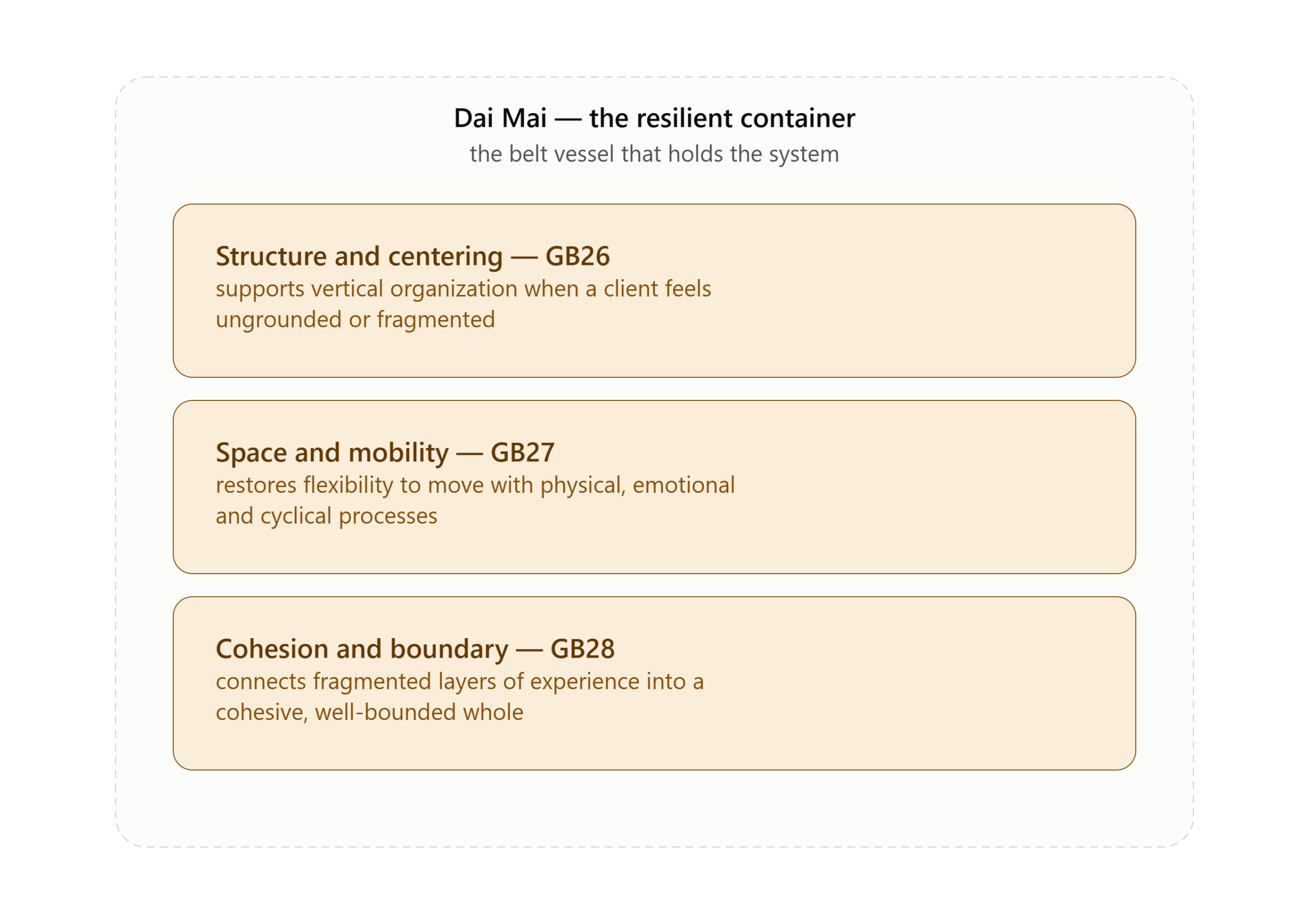
Dai Mai approached as a resilient container for the nervous system within this exploratory Shiatsu model.
The Central Vessels: The Core of Transformation
From within this safe boundary, the action of the central vessels — Ren, Du, and Chong Mai — unfolds. Here, we touch the vital core of the system: the deep dynamics where essential change takes place. At this level, the practitioner can utilise the opening point of the respective meridian to attune to the central theme emerging within the client:
- Ren Mai — LU7 (Lieque — ‘Broken Sequence’): Focus on self-care, nourishment, and embodying our inner wisdom.
- Du Mai — SI3 (Houxi — ‘Back Stream’): focus on autonomy, direction, and the capacity to stand upright in the world.
- Chong Mai — SP4 (Gongsun — ‘Grandfather-Grandson’): focus on the vital origin, the blueprint of being, and deep constitutional transformation.
Together, these four primary vessels — Dai, Ren, Du, and Chong Mai — form a structural framework in which the client experiences not only energetic support, but where space is opened up for a fundamental reorganisation of their entire being.
2.3.3 Phase 3: Integration and Coherence (Yin and Yang Wei Mai)
The Yin and Yang Wei Mai function as connecting channels that forge the system into a coherent whole (Giovanni Maciocia, 2006; Ann Cecil-Sterman, 2013). In this final phase of the model, they support the integration of the client’s internal process, helping to ensure that what has been set in motion during the session takes lasting root in everyday functioning:
- Yin Wei Mai — PC6 (Neiguan — ‘Inner Gate’): This point opens the vessel that interconnects the Yin meridians. Although the Yin Wei Mai is often associated with accessing the inner world, within this model it fulfils a crucial role in integration: it helps to weave the insights gained and the deep transformation from the central vessels into the structure of the heart and the self-image.
- Yang Wei Mai — SJ5 (Waiguan — ‘Outer Gate’): This point opens the vessel that interconnects the Yang meridians. It supports the client in carrying this new energetic balance outward, into their interactions with the environment and the demands of everyday life.
Together, the Wei Mai form the essential bridge from the treatment space back into lived reality, ensuring that the transformation initiated in Phase 2 does not remain a temporary experience, but becomes a sustained change.
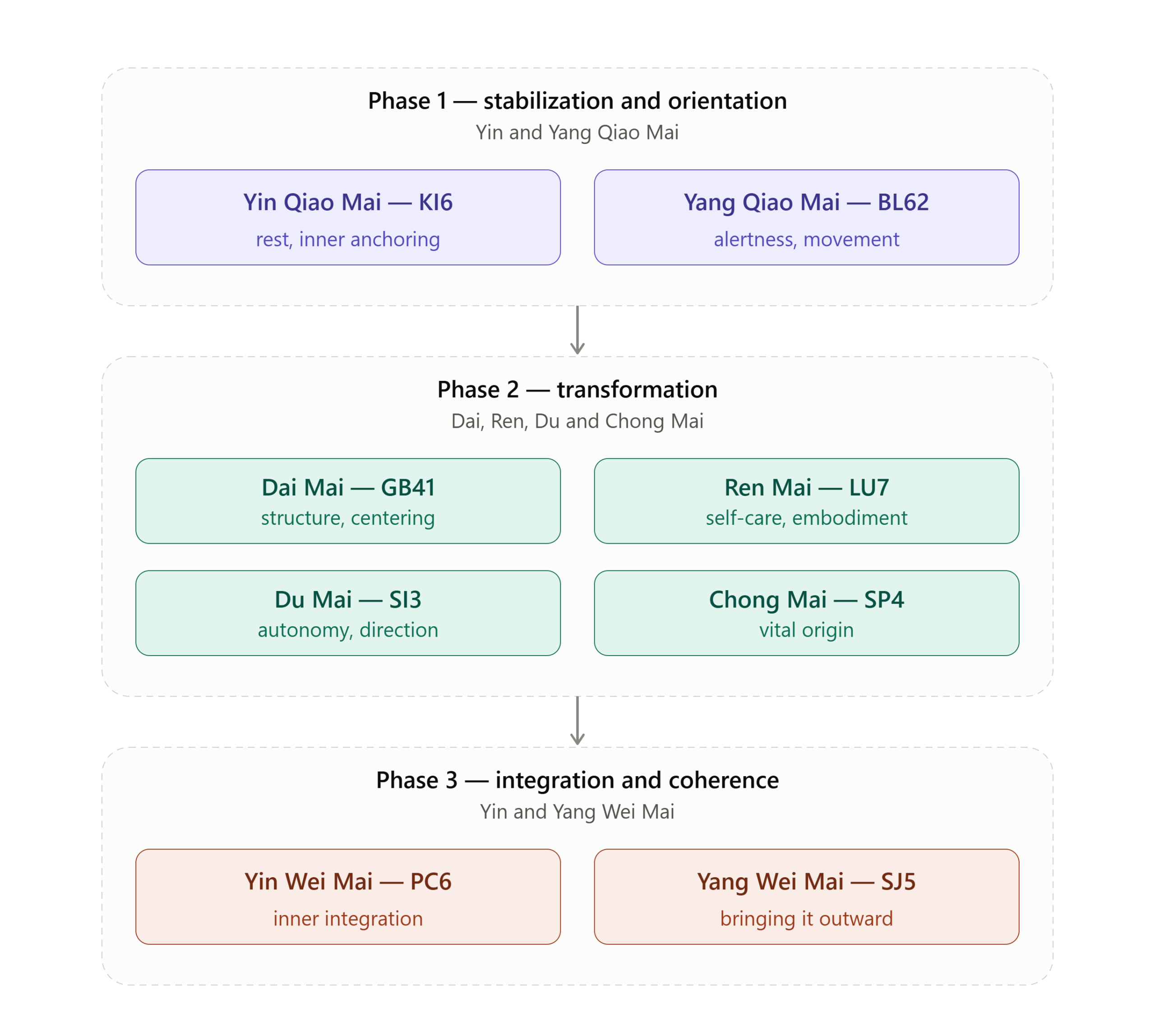
A heuristic three-phase model for working with the Extraordinary Meridians in Shiatsu: Stabilization, Transformation, and Integration.
2.4 Contextualizing the Model
This three-phase model is offered as an expansion of existing clinical application models for the Shiatsu practitioner. It provides a broader perspective on the potential sequence in which the Extraordinary Meridians can be applied within a session.
Within this model, only a few fundamental base and opening points are intentionally discussed to illustrate the core dynamics of each phase. It is deliberately left to the expertise, clinical intuition, and experience of the Shiatsu practitioner to flesh out this framework according to their own insights and to incorporate other specific points, intersection points, or pathways of the Extraordinary Meridians into the session. After all, clinical practice always demands flexibility and attunement to the unique needs of the client.
Furthermore, depending on the context, the sequence may be adapted and priority may be given to different Extraordinary Meridians. For instance, within the framework of pregnancy support (Suzanne Yates, 2003), the Chong Mai is often emphasised early in the process due to its profound constitutional and developmental role, whereas in other Shiatsu contexts, other Extraordinary Meridians may take precedence.
Closing Remarks: An Interlude to the Dance of Qi
This first part has explored the historical and theoretical foundations of the Extraordinary Meridians and introduced a heuristic, interpretative model for their application in Shiatsu.
In Part 2, the focus shifts from concept and structure toward experience and movement. The Extraordinary Meridians are approached as a choreographic field of Qi, in which the Yin and Yang Qiao Mai appear as dance partners within a living energetic dynamic.
References & Sources
Classical Texts
- Li Shizhen. Qi Jing Ba Mai Kao (Study of the Eight Extraordinary Meridians). Ming Dynasty.
- Huangdi Neijing (Yellow Emperor’s Inner Classic): Suwen & Ling Shu.
- Nan Jing (Classic of Difficult Issues).
Modern Literature (Shiatsu & Acupuncture)
- Cecil-Sterman, A. (2013). Advanced Acupuncture: A Clinic Manual. Classical Wellness Press.
- Ferrando, A. (2022). Les Merveilleux Vaisseaux: Manuel de pratique clinique. Éditions Quintessence.
- Kaatz, D. (2020). The Art of Spiritual Acupuncture: Sacral-Cranial Touch, Plant Spirits, and the Cosmos. Petite Bergerie Press.
- Maciocia, G. (2006). The Channels of Acupuncture. Churchill Livingstone.
- Volf, N. (2020). La Symphonie des Méridiens du Corps. Éditions de l’Observatoire.
- Yates, S. (2003). Shiatsu for Midwives. Elsevier Health Sciences.
Somatic & Psychological Sources
- Heller, L., & LaPierre, A. (2012). Healing Developmental Trauma (NARM). North Atlantic Books.
- Levine, P. A. (2010). In an Unspoken Voice: How the Body Releases Trauma and Restores Goodness. North Atlantic Books.
- Roth, G. (1989). Maps to Ecstasy: Teachings of an Urban Shaman. New World Library.
- Shapiro, F. (1989). Efficacy of the eye movement desensitization procedure in the treatment of traumatic memories. Journal of Traumatic Stress, 2(2), 199-223.
Read Part 2 here, ‘The Dance of Qi as a Mirror for the Shiatsu Practitioner‘ where we explore the Extraordinary Meridians as a living choreography within Shiatsu.